


IIPF Young Economists Award
The "IIPF Young Economists Award" was instituted in 2008, with the aim of encouraging young scholars who present their papers at the IIPF Annual Congress. An award committee, headed by the Scientific Chair of the respective congress and including further members, selects those papers presented at the congress that stand out for their scientific quality, creativity and relevance, and chooses up to two of them to be distinguished with this award.
The same rules apply for this award as for the "IIPF Peggy and Richard Musgrave Prize", namely that authors must be under 40 years old, that in the case of co-authored papers, all authors need to be under 40, and that age is measured as at the ending day of the Congress, when the prize is awarded. Authors who wish to be considered for this award should indicate this when submitting their papers for presentation at the Congress.
The IIPF gave the Young Economists Award in 2025 to:
Laura Montenbruck (Stockholm University) for her paper "Fiscal Exchange and Tax Compliance: Strengthening the Social Contract Under Low State Capacity." | 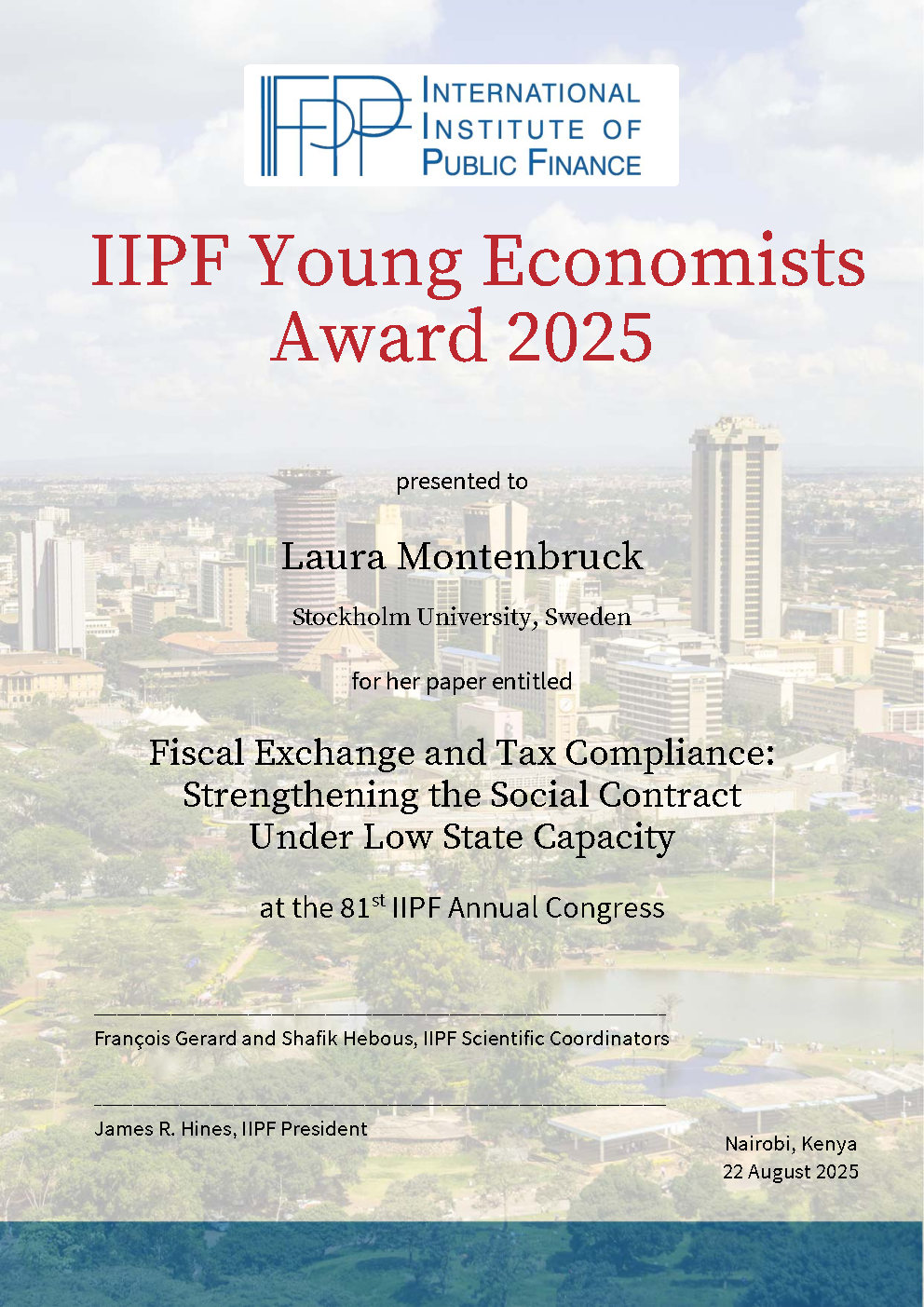 |
Previous IIPF Young Economists Award Laureates
| Year | Author(s) | Title of Paper |
|---|---|---|
| 2024 | Jacopo Bassetto and Giuseppe Ippedico | Can Tax Incentives Bring Brains Back? Returnees Tax Schemes and High-Skilled Migration in Italy |
| Sebastien Laffitte | The Market for Tax Havens | |
| Valeria Zurla | How Should We Design Parental Leave Policies? Evidence from Two Reforms in Italy | |
| 2023 | Arun Advani, David Burgherr and Andy Summers | Taxation and Migration by the Super-Rich |
| William Dodds | Solving Multidimensional Screening Problems Using a Generalized Single Crossing Property: Applications to Optimal Taxation | |
| Ilona Tsanko | Would You Like To Super-Size Your Car? The Effect Of Environmental Subsidies On Emissions | |
| 2022 | Enrico Rubolino | Taxing the Gender Gap: Labor Market Effects of a Payroll Tax Cut for Women in Italy |
| 2021 | Anja Roth and Michaela Slotwinski | Gender norms and income misreporting within households |
| 2020 | Ashley Cooper Craig | Optimal Income Taxation with Spillovers from Employer Learning |
| Andreas Gerster and Michael Kramm | Correct Me if You Can – Optimal Non-Linear Taxation of Internalities | |
| Arezou Zaresani | Adjustment Cost and Incentives to Work: Evidence from a Disability Insurance Program | |
| 2019 | Adrian Lerche | Investment Tax Credits and the Response of Firms |
| Mathilde Muñoz | Do European Top Earners React to Labour Taxation Through Migration? | |
| 2018 | Daniel Reck & Jacob Goldin | Optimal Defaults with Normative Ambiguity |
| 2017 | Arthur Seibold | Statuory Ages as Reference Points for Retirement: Evidence from Germany |
| Samuel Stolper | The Role of Local Pass-Through | |
| 2016 | Eric Ohrn | Investment and Employment Responses to State Adoption of Federal Accelarated Depreciation Policies |
| Pierre Bachas | Not(ch) Your Average Tax System: Corporate Taxation Under Weak Enforcement | |
| 2015 | Miguel Almunia & David Lopez-Rodriguez | Heterogeneous Responses to Effective Tax Enforcement: Evidence from Spanish Firms |
| Francesca Carta & Lucia Rizzica | Female employment and pre-kindergarten: on the unintended effects of an Italian reform | |
| Irem Guceri & Li Liu | Effectiveness of fiscal incentives for R&D: a quasi-experiment | |
| 2014 | Maria Coelho | Dodging Robin Hood: Responses to France and Italy's Financial Transaction Taxes |
| Jarkko Harju and Tuomas Kosonen | The inefficiency of reduced VAT rates: Evidence from restaurant industry | |
| Olga Malkova | The Effect of Paid Parental Leave and a Child Benefit on Fertility | |
| 2013 | Pierre Bachas & Anders Jensen | Information Trails, Tax Compliance and Development |
| Bas Jacobs & Floris Zoutman | Optimal Redistribution and Optimal Monitoring of Labor Effort | |
| Andreas Steiner | A Tale of Two Deficits: Public Budget Balance of Reserve Currency Countries | |
| 2012 | David Agrawal | Inter-Federation Competition: Sales Tax Externalities with Multiple Federations |
| Felix Bierbrauer & Pierre Boyer | Political Competition and Mirrleesian Income Taxation: a First Pass | |
| Ronny Freier & Christian Odendahl | Do Parties Matter? Estimating the Effect of Political Representation in Multi-Party Systems | |
| 2011 | Raphael Parchet & Beatrix Brügger | Culture and Taxes: Towards Identifying Tax Competition |
| Craig Garthwaite | The Doctor Might See You Now: The Supply-Side Effects of Public Health Insurance Expansions | |
| Aart Gerritsen | Equity and Efficiency in Rationed Labor Markets | |
| 2010 | Johannes Rincke & Ferdinand Mittermaier | Do Countries Compensate Firms for International Wage Differentials? |
| 2009 | Ronald Davies & Johannes Voget | Tax Competition in an Expanding European Union |
| José Carlos Assi Kimou | Economic Conditions, Enforcement and Criminal Activities in the District of Abidjan | |
| Martial Foucault, Emilie Caldeira & Grégoire Rota-Graziosi | Public Spending Interactions among Beninese Municipalities< | |
| 2008 | Johannes Becker & Nadine Riedel | Corporate Taxation and Multinational Firms - Empirical Evidence on Welfare Implications |
| T.Scott Findley & Frank N. Caliendo | Short Horizons, Time Inconsistency, and Optimal Social Security | |
| Gabrielle Fack & Camille Landais | Are Fiscal Incentives Towards Charitable Giving Efficient: Evidence from France | |